Some Pre-Columbian History
The Nazca People and Mesoamerican Cultures
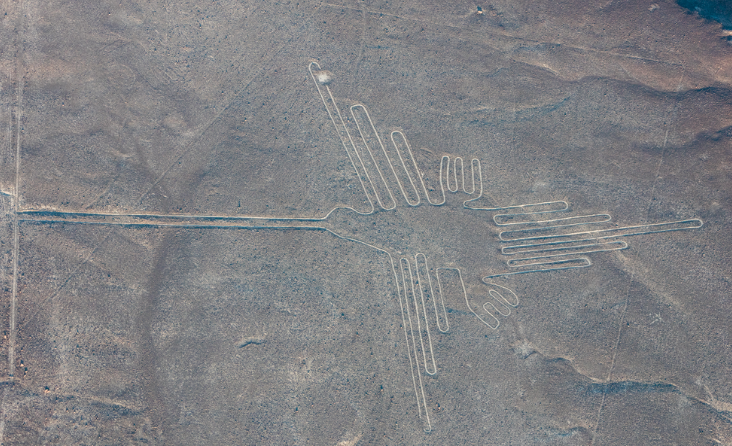
The hummingbird is present within every known Mesoamerican culture, and it is often associated with the sun, war, and the afterlife. The Nazca people of Peru, for example, created a famous geoglyph known as "The Hummingbird" that is part of the larger Nazca Lines (a series of large ancient geoglyphs in the Nazca Desert). You probably know it from school. These incredible works of art are estimated to be as old as 200 BCE.
The Aztecs
Huitzilli is the name of the hummingbird in the Nuahtil language, and it is also the name of a hummingbird deity in Mesoamerican cultures. Fast-forward to the 14th to 16th centuries, and the Nuahtil words huitzilli (hummingbird) and opochtli (left) are combined to form Huitzilopochtli.
Neat fact: "left" as used as the translation of opochtli is correct, but a proper modern interpretation of the word would be "to the left of the rising sun," or "South." For the Aztecs, the sun's path from east to west were the only cardinal directions, making the left side of the sun's path to what we'd call the South.
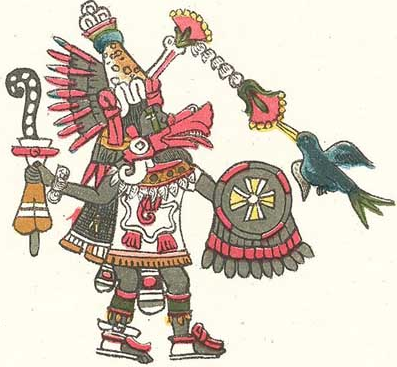
So, Huitzilopochtli, the "Hummingbird of the South," is the name given to the Aztec's principal god. The Aztecs recognized in the hummingbird all the attributes necessary to be a good warrior and this bird became its main symbol.
The Aztec Pilgrimage to the Promised Land (Conquest of Mexico)
Around the year 1168, the Aztecs started a roughly century-long journey to reach the valley of Mexico, a promised land foretold by prophecy. During the pilgrimage to the promised land, Huitzilopochtli encouraged the journey and punished those who became discouraged along the way. He appeared with the form of a hummingbird that endlessly repeated:
"Let’s march, let’s march!”
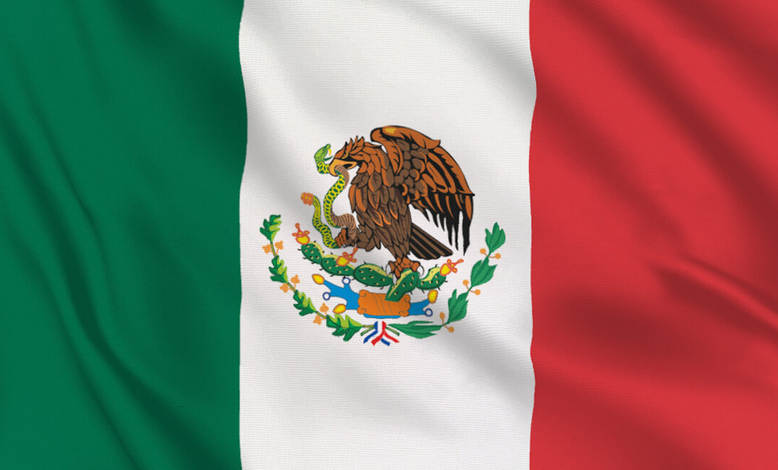
The chosen place, according to prophecy, had to be on the shores of a lake where they would find an Eagle perched on a cactus sprouting from a rock and holding a snake. The symbol that became the National Coat of Arms of Mexico; the shield of the Mexican flag.
Mayan Creation Story of the Hummingbird
Scholars of Mexican pre-Columbian cultures have interpreted a Mayan creation story for the hummingbird. It tells that, after creating all things on Earth, the Gods noticed that they were missing someone to take their wishes and thoughts from one place to another. Having already made the other animals, they had run out of corn and clay to create any more. Instead they took a jade stone, carved a small arrow and blew on it to bring it to life. The humans, astonished by the beauty of the bird, tried to hunt them to possess their feathers, but the Gods saw that and stated that anyone who dared to catch a hummingbird could receive death as punishment.
The 16th Century Friar Berardino de Sahagún and the Florentine Codex
From 1545 to 1590, Spanish Franciscan Friar Berardino de Sahagún, wrote dhe Florentine Codex, or "General History of the Things of New Spain". With the help of Nahua elders and students, he compiled a comprehensive record of Aztec life, including cosmology, rituals, social structure, and the conquest of Mexico. It included more than 2,000 illustrations, and in it he describes how the Aztecs believed that Huitzilopochtli was born.
His mother, the goddess Coatlicue, was sweeping the Temple as a penance when she encountered a ball of feathers Some interpretations say "bundle" of feathers. She collects the feathers and places them in her bosom. By miracle, she becomes pregrnant. Her daughter Coyolxauhqui and her 400 sons, the Centzon Huitznahua, were outraged by this and plotted to kill their mother. However, Huitzilopochtli is immediately born grown and fully armed, and immediately killed his sister and brothers.
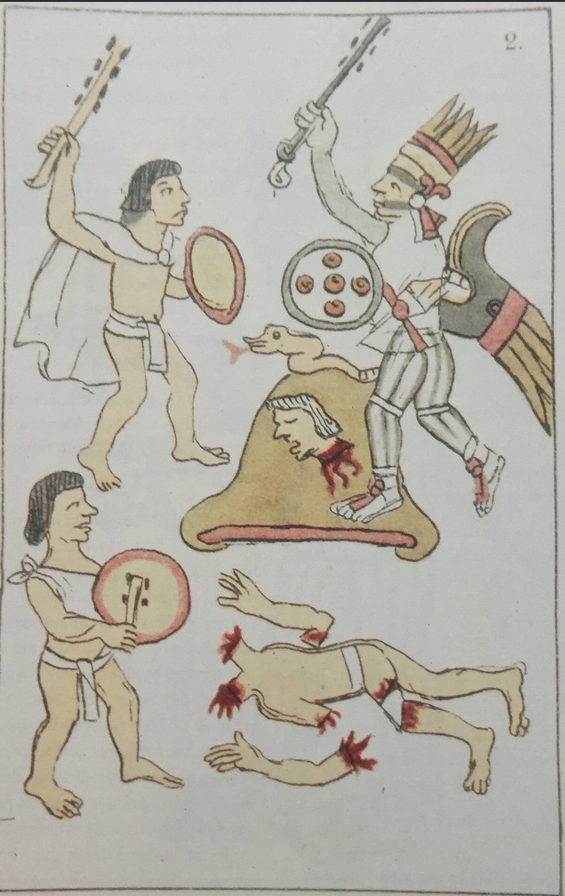
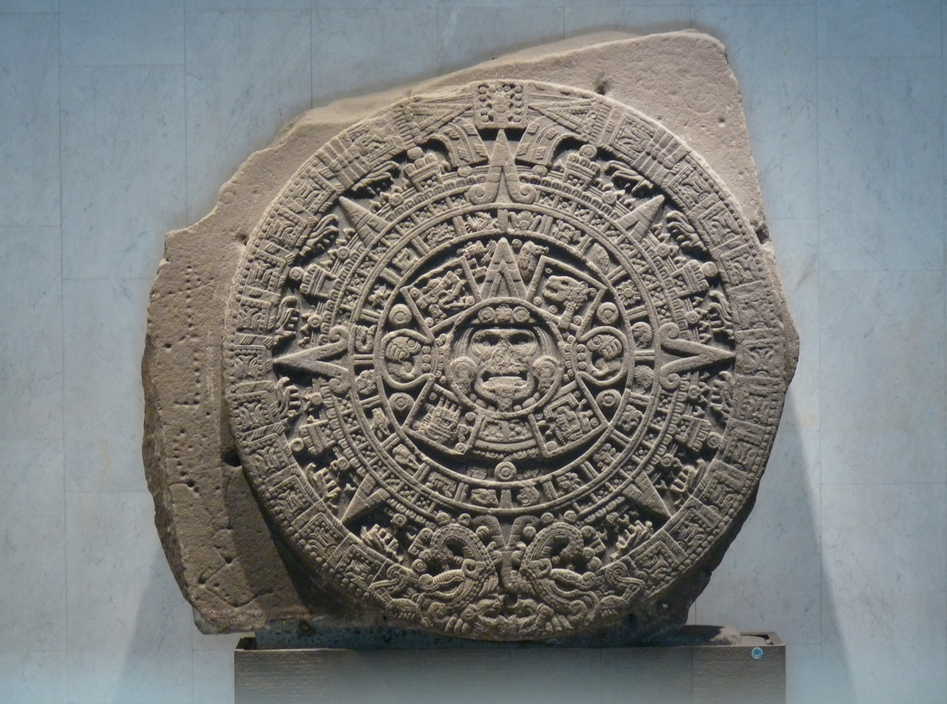
This story is often interpreted as a metaphor for the sun's victory over the moon and stars, with Huitzilopochtli representing the sun, Coyolxauhqui the moon, and the Centzon Huitznahua the stars. The story is also depicted in the famous Aztec Calendar Stone, where Huitzilopochtli is shown in the center, surrounded by the symbols of the moon and stars.